8 Signs an Internal Support Playbook Needs Updating
Use eight evidence-backed signals to decide when an internal support playbook needs verification, revision, consolidation or retirement.
A playbook can look polished and still send an agent down an obsolete path. It can also be old and remain accurate. The useful question is not “When was this page edited?” but “What evidence says its instructions, audience and ownership still fit the work?”
KCS reuse guidance treats use as a review opportunity while context exists. The Zendesk verification workflow records whether knowledge is current or needs review. Atlassian source-quality guidance warns about inaccurate, vague, conflicting, outdated or duplicated material. Microsoft lifecycle guidance shows how versions and approvals can structure knowledge work. These are attributed operating examples, not a universal review cadence.1389
Use the eight signs below as review triggers. For each one, capture the affected passage, the current evidence, the fact owner and the decision. Keep “verified,” “revised” and “retired” as distinct outcomes.
The short answer
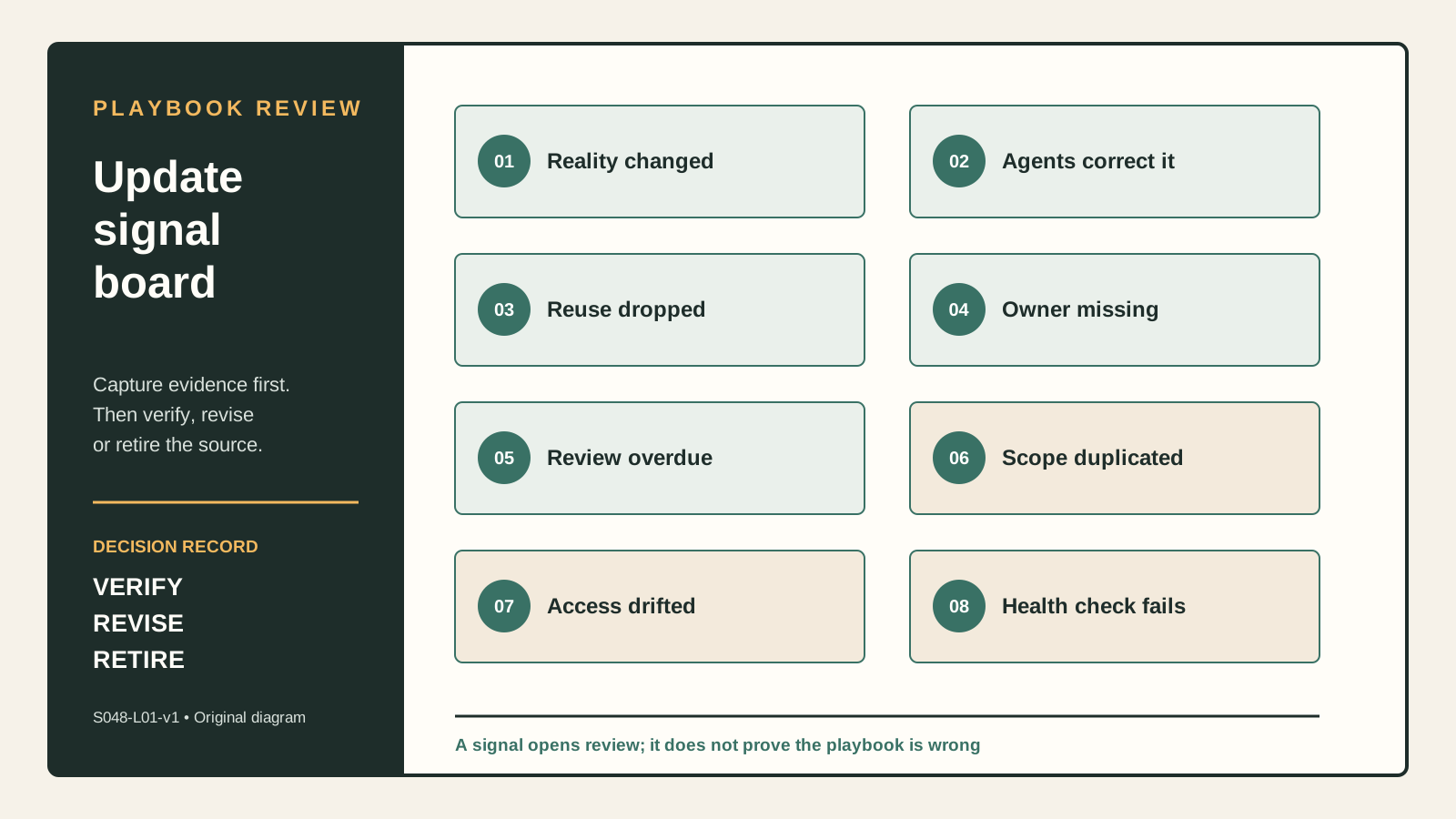
An internal support playbook needs review when operating reality changed, agents repeatedly correct it, intended reuse declines, no current owner can verify it, its review trigger is overdue, another source claims the same scope, its audience or access boundary drifted, or it fails a content-health check. Each signal opens an evidence review; none alone proves the playbook is wrong or should be deleted.
1. A step no longer matches the product, policy or workflow
- When it helps
- Use this when a release, policy decision or operating change affects a documented step.
The playbook names a screen, rule, entitlement or escalation path that changed.
Record the exact sentence or step, the authoritative current behavior and the change that created the mismatch. Do not use the article age as a proxy for accuracy. A recently edited playbook can still be wrong, while an older stable procedure can remain valid.
Zendesk describes verification as a decision that an article is accurate and current or needs review. Microsoft’s knowledge-lifecycle controls show versioning and approval as deliberate states. Treat the product or policy owner’s confirmation as the evidence for the replacement step, not the calendar alone.39
Boundary: this sign is about a confirmed change in operating reality. It does not cover software selection or a portfolio-wide audit.
Review notes
- What to watch
- A rapid edit restores the common path, but publishing before the fact owner confirms it can replace one stale instruction with another.
2. Agents repeatedly correct or flag it during real work
- When it helps
- Use this when several agents make the same correction, workaround or clarification in context.
The usable answer survives in tickets, chat or memory while the shared procedure stays wrong or incomplete.
Keep links to the correction or flag, the affected section and the case context. Group repeated observations before changing a general rule, and separate the normal path from a documented exception.
KCS describes reuse as a review opportunity while context exists and encourages users to fix or flag knowledge through a fast closed loop. Zendesk likewise recommends a process for agents to flag documentation issues and subject-matter review.156
Boundary: one unusual ticket is evidence to examine, not automatic proof that the global procedure should change.
Review notes
- What to watch
- Folding repeated feedback into the playbook reduces drift, but one exceptional case may need a scoped note instead of a general rule.
3. The intended team stops reusing the playbook
- When it helps
- Use this after confirming that the playbook is meant to support the workflow being observed.
Private notes, copied snippets or tribal knowledge replace the shared source.
Ask three separate questions: can agents find it, do they trust it and do they still need it? Compare the intended audience and workflow with observed references or agent feedback. Low reuse can indicate stale content, a weak title, missing access or a retired process.
KCS ties review to reuse, while Atlassian distinguishes internal knowledge such as runbooks and procedures from external material. Together, those sources support investigating the working context before deciding what the signal means.17
Boundary: low reuse opens a review. It is not a deletion rule and it is not the retrieval-quality test owned by S048-L03.
Review notes
- What to watch
- Investigating low reuse takes time, but deleting or rewriting without diagnosis can hide a findability or access problem.
4. No current owner can verify the facts or accept an update
- When it helps
- Use this when an update stalls between subject-matter experts, content maintainers and publishers.
People can see a defect, but nobody is accountable for confirming or publishing the correction.
Name the fact owner, the content maintainer and the person who can approve publication. Record how a technical question reaches the fact owner and how accepted changes return to the shared article.
Zendesk recommends accountable ownership, distributed subject-matter participation and authorized verification. Those roles can be combined in a small team, but the decision authority should still be explicit.563
Boundary: this sign diagnoses an ownership gap for one playbook. S048-L02 owns the separate question of assigning ownership across the article portfolio.
Review notes
- What to watch
- Assigning a temporary owner can unblock a correction, but it must not imply authority that the person does not have.
5. Its verification trigger is overdue or disconnected from change
- When it helps
- Use this for playbooks whose risk or rate of change warrants a recorded verification trigger.
A reminder exists, but the article was not reviewed when the underlying process changed.
Record the last verified date, the next review trigger and the product, policy or process events that should force an earlier review. Choose the interval from risk and rate of change rather than copying a universal cadence.
Zendesk documents rules that can unverify articles and notify owners at configured intervals. Microsoft documents versions, approval, scheduled publication and expiration as lifecycle controls. These are examples of trigger mechanisms, not proof that elapsed time makes content wrong.49
Boundary: an overdue date identifies missing assurance. Confirm the facts before changing the procedure.
Review notes
- What to watch
- Short intervals can create review fatigue; long intervals can leave critical instructions unexamined.
6. Another source now claims the same operational scope
- When it helps
- Use this after a known duplicate, partial copy or conflicting instruction has been identified.
Agents can find two procedures but cannot tell which one governs the workflow.
Name the other source, compare intended audience and authority, and mark which record governs each overlapping instruction. Preserve a link or transition note when another audience still needs the surrounding context.
KCS content-health indicators include uniqueness, and Zendesk recommends searching existing documentation before creating new material. Atlassian warns that duplicated or conflicting source material can reduce answer quality.258
Boundary: this article handles a known duplicate as one signal. S048-L05 retains the methods for systematically finding conflicting answers.
Review notes
- What to watch
- Consolidation improves authority, but retiring a source too early can remove context needed by a distinct audience.
7. The audience or access boundary no longer fits the content
- When it helps
- Use this when team roles, channels, content sensitivity or publishing permissions change.
Sensitive internal steps became too visible, or the intended agents lost access to the working procedure.
Recheck who needs the procedure, whether it contains sensitive internal steps and which roles may view, edit, approve and publish it. Separate internal troubleshooting detail from customer-facing guidance when the audiences need different information.
Zendesk recommends defining internal scope and permissions. Atlassian describes internal knowledge as a place for agent runbooks, procedures and sensitive troubleshooting guidance, with separation from external access.67
Boundary: follow the organization’s approved security and information-classification policy. This guide does not create a legal or security classification.
Review notes
- What to watch
- Narrow access protects internal detail, while access that is too narrow pushes agents back to private copies.
8. It fails a basic content-health check
- When it helps
- Use this after technical facts are checked, or when agents report that a correct article is still difficult to use.
The procedure may be accurate yet hard to find, incomplete, unclear or linked to unavailable evidence.
Check uniqueness, completeness, clarity, title fit, persistent links and metadata. Record each failed item separately, because the remedy for a vague title differs from the remedy for a missing exception or broken source link.
KCS lists those elements as content-health indicators. The checklist measures how well the article meets a content standard; it does not prove that the underlying procedure works.2
Boundary: pass technical accuracy and content health separately. Do not mark a playbook verified merely because its format is clean.
Review notes
- What to watch
- Standardizing structure improves reuse, but cosmetic cleanup cannot replace a technical accuracy review.
Putting it into practice
A trustworthy playbook has more than a current date. Its facts match the operating environment, its intended team can find and use it, an accountable owner can verify it, and its scope and access remain clear.
When a signal appears, capture evidence and make one explicit decision: verify the current source, revise the affected passage, consolidate an overlap or retire the playbook with a transition path. Support Knowhow’s guide index will add separate reviewed guides for portfolio ownership, retrieval quality, software selection and conflict discovery.
Sources
- Technique 2.1: Reuse is Review
Checked 6 November 2026 · Knowledge should be reviewed while it is being used and context exists; users should fix or flag needed improvements through a fast closed loop.
- Technique 5.4: Content Health Indicators
Checked 6 November 2026 · A content-health checklist can test uniqueness, completeness, clarity, title fit, persistent links and correct metadata.
- Verifying articles that need review
Checked 6 November 2026 · Verification records whether an article is accurate and current or needs review; authorized owners, publishers or admins review, update and verify it.
- Setting reminders to review and verify articles
Checked 6 November 2026 · Verification rules can unverify articles and notify owners at configured intervals based on labels, categories or update date.
- Best practices: Developing content for your knowledge base
Checked 6 November 2026 · A knowledge base needs an accountable owner, a process for agents to flag issues, consistent templates and subject-matter review; agents should search existing documentation before creating duplicates.
- Best practices for creating an internal knowledge base
Checked 6 November 2026 · Internal content should have a defined scope, suitable access permissions, distributed subject-matter ownership and a way for agents to flag outdated, inaccurate or missing material.
- The difference between internal and external knowledge bases
Checked 6 November 2026 · Internal knowledge can contain agent runbooks, procedures and sensitive troubleshooting guidance; separating internal and external access helps protect sensitive content and present the right material to each audience.
- Set up your knowledge base to improve the quality of AI answers
Checked 6 November 2026 · Incorrect, vague, conflicting, outdated or duplicated source material can reduce answer quality; Atlassian recommends accurate, current, clear and nonduplicated knowledge.
- Overview of knowledge management
Checked 6 November 2026 · Knowledge article lifecycle controls can include versions, approval, scheduled publication and expiration.
How this guide was researched
Prepared from the approved S048-L01 research and independently checked against nine current official KCS, Zendesk, Atlassian and Microsoft sources on 6 November 2026. Vendor and KCS workflows remain attributed examples rather than universal guarantees. The eight-signal decision record, fictional account-access example and code-native SVG are original editorial work. No customer records or private knowledge-base content were accessed. Historical Ahrefs US volume 50 from 22 October 2026 is retained; current difficulty, parent topic and SERP rows remain unknown because connected units are exhausted and no new request was sent. Publisher-practice, legal, site launch, deployment, live and publication gates remain pending.
An eight-signal evidence record for deciding whether one internal support playbook needs verification, revision, consolidation or retirement.
Editorial standards